Curated and text by Ilija Prokopiev and Marija Hristova
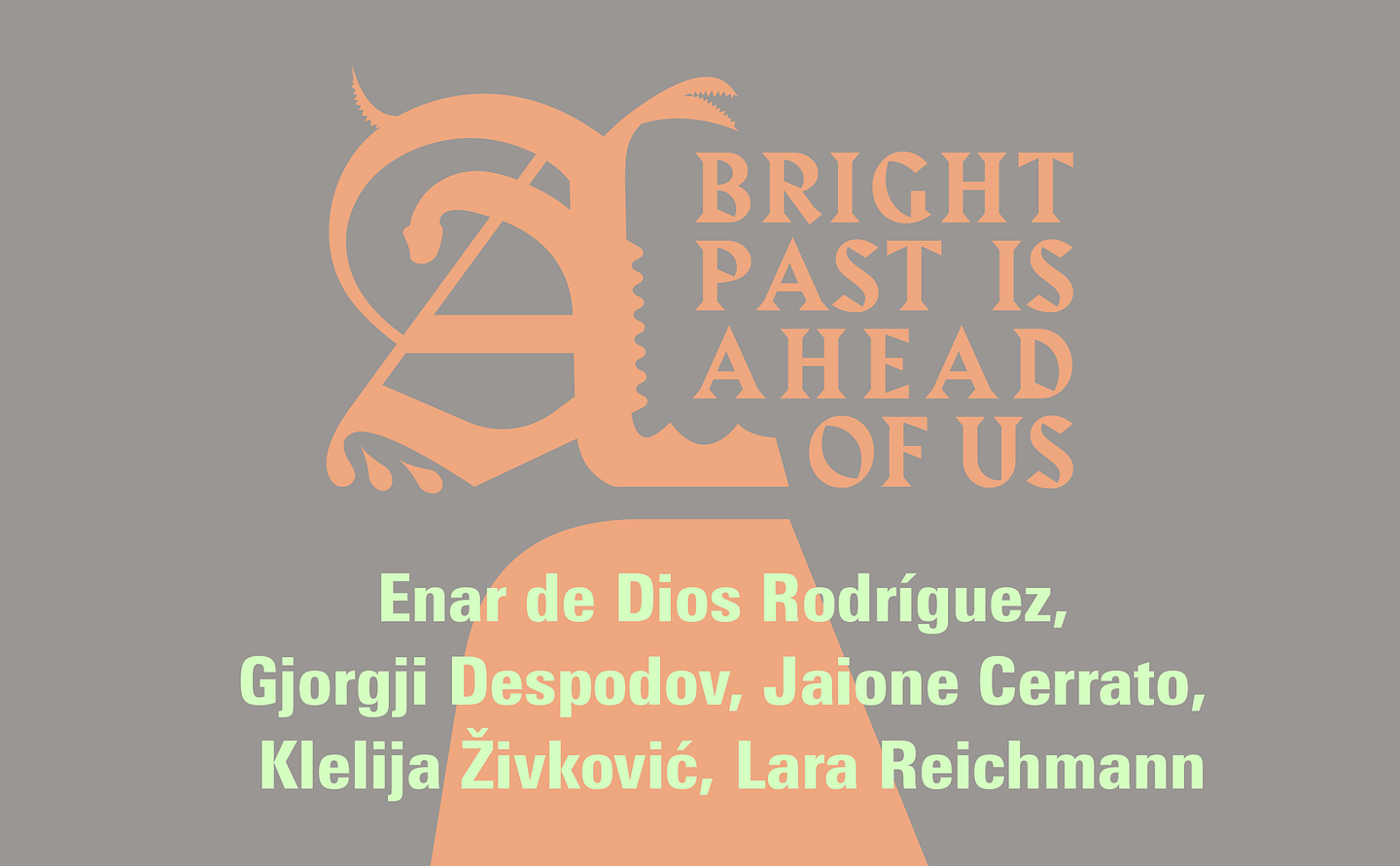
A Bright Past Is Ahead of Us explores the unsettling concept of generational promises—ideals and beliefs passed down through lineage that bind us to expectations we may neither trust nor identify with. Using the theory of fairy tale narrative codes as a curatorial pretext, the exhibition features works by five artists, Enar de Dios Rodríguez, Gjorgji Despodov, Jaione Cerrato, Klelija Živković, and Lara Reichmann, who envision narratives that challenge our understanding of human and social relations. Set in a semi-darkened space that masks unease, the exhibition contrasts fantastical and poetic elements with stark political, environmental, and economic realities. It becomes a site for layered reflection and dialogue, guided by speculative design and documentary methodologies.
Fairy tales articulate the relationship between narrator and audience, using shared narrative codes that bind the genre. According to Roland Barthes’ structural analysis, mastery over these codes determines the effectiveness of the storyteller. The narrator’s role is not merely to invent stories but to skillfully navigate the established codes in connection with the audience. Therefore, fairy tales reflect human psychology and societal values, nurturing identification in people and reinforcing ideals such as the notion of “happily ever after.” Passed down through generations, they preserve shared values and strengthen communal bonds.
Fairy tales offer a safe space, contained by the promise that good will triumph over evil as long as the lesson is learned. The narrative arc, framed by “once upon a time” and “happily ever after,” provides a comforting sense of order. Psychologists argue that the darkness inside these endpoints is essential, allowing symbolic confrontation of fears. Still, the fairy tale remains a protected space, anchored by faith in a positive outcome. But without this, the tale mirrors real-life uncertainty: heroes may falter, and danger may not be overcome. This, in turn, invites a deeper question: What are the contours of uncertainty in a world where “happily ever after” is no longer a sufficient answer?
A Bright Past Is Ahead of Us confronts the shattered promise of a bright future passed down through generations in the face of contemporary challenges such as human rights violations, wars, environmental crises, and economic upheavals. The featured artists, representing diverse backgrounds, guide us through narratives that examine reality through interdisciplinary, research-driven, and collaborative practices, framing the present as a space of anxiety and responsibility and a catalyst for breaking the codes of inert behaviour.
Enar de Dios Rodríguez interrogates the physical and conceptual politics of space, revealing the infrastructures and ideologies that shape our sense of ownership, freedom, and belonging. In her video essay Above All, she turns her gaze skyward, challenging the romantic notion of the sky as boundless and untouched. Instead, she exposes it as a contested zone—occupied, surveilled, and exploited. Through poetic narration and layered visuals, Rodríguez resists linear storytelling, favouring fragmentation to provoke reflection on access, the commons, and systems that shape our environments.
Gjorgji Despodov explores memory, material culture, and speculative futures. His practice critiques societal norms and digital overconsumption, questioning what we preserve or discard and what legacy we leave behind. In Where I Post From, Despodov reimagines the technology as an artefact of the future. Through 3D-printed forms and fictional archives, he examines how data-driven societies construct meaning and heritage, prompting us to reconsider the roles and values passed to future generations.
Jaione Cerrato’s practice critically examines how we frame, aestheticise, and distance ourselves from nature. Rooted in ecological thought and speculative futures, her work challenges the anthropocentric gaze that reduces nature to image, symbol, or resource. In Framed, Cerrato exposes our paradoxical desire to protect and control the natural world, questioning the aestheticisation embedded in everyday visual culture. Through minimal imagery and poetic text, she invites reflection on our place within a living, interdependent system in transformation.
Klelija Živković’s artistic practice explores aliveness as a radical form of resistance—an embodied response to systems of oppression, inherited shame, and emotional suppression. Her work invites us to see aliveness not as a given but as a skill: something to be learned, nurtured, and shared. Through her works, Živković constructs spaces where emotional truths are both confronted and transformed. She offers a language for resilience—one grounded in emotion, collectivity, and the quiet power of staying present in a world that often demands disconnection.
Lara Reichmann analyses how marginalised bodies—especially women’s—are transformed within systems of labour, science, and technology. Merging historical fact with speculative fiction, she reveals how essential contributions are overlooked or mechanised. In Disposable Bodies, she reflects on the Women Astronomical Computers, using metaphor and poetic narrative to question who is remembered and how bodies become disposable in data-centric systems.
The works featured in the exhibition contribute to exploring questions about the future and inherited promises, each offering a distinct perspective. In embracing uncertainty, the exhibition invites viewers to question familiar narratives, break away from entrenched patterns, and actively shape a more conscious and hopeful future.